Programmes teaching
TRI AI Saturdays
A community-led AI study group running cohorts of learners through structured curricula, peer learning, and mentorship.
- Cohort
- Cohort 10 running now · applications for Cohort 11 announced via the newsletter
- Cadence
- 16-week cohorts, multiple per year
- In partnership with
- Google DeepMind (Cohort 10)
- Status
- active
Our story
AI Saturdays Lagos began in 2018 as a small community study group of enthusiasts who wanted to bridge the distance between curiosity about AI and the structured knowledge most lacked access to. The first cohort had five teams exploring the major deep learning frameworks of the era: PyTorch, TensorFlow, Keras, Theano, and Nervana Neon. Each team published their findings as public writeups.
Nearly a decade later, the programme has grown into a continent-spanning network of alumni working at AI labs, research groups, and product teams. Several alumni return as mentors and instructors for subsequent cohorts. The programme is now run under the TRI AI umbrella alongside research initiatives like the Sauti Project and ChowNet.
What participants do
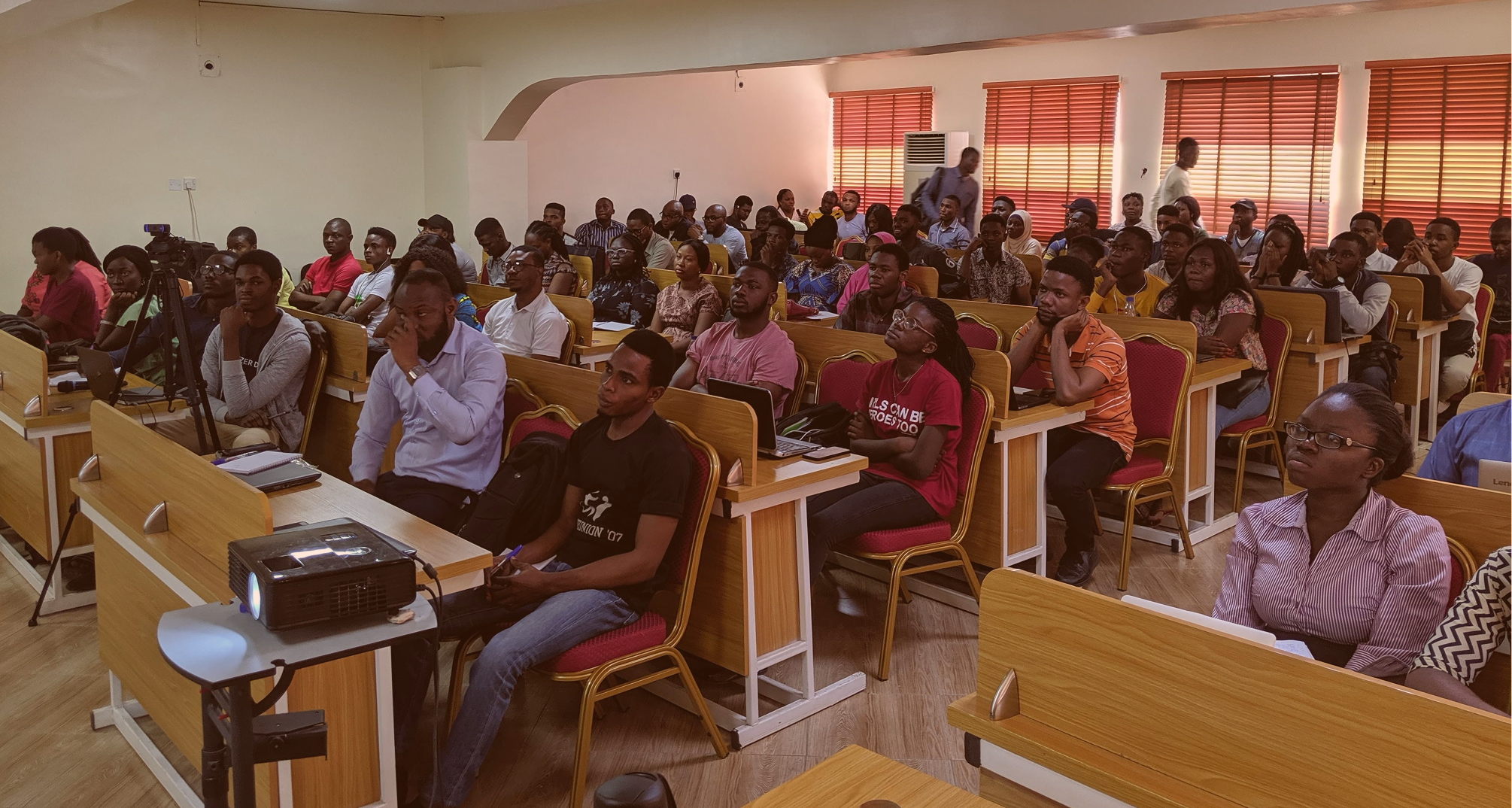
- Work through curated AI and ML curricula at a structured pace, typically over 16 weeks
- Meet weekly, in-person or online, for discussion, doubt-clearing, and project work
- Pair with mentors drawn from industry and research, including programme alumni
- Build a capstone project in teams, presented publicly at cohort end
- Publish project writeups on Medium, GitHub, or YouTube as part of the open community record
Recent cohorts have used a flipped-classroom model, where participants watch curated pre-recorded lectures during the week and meet every Saturday for live community discussion, Q&A, and accountability.
Curriculum
Curriculum has evolved across cohorts to reflect where the field is moving. Recent cohorts have drawn from:
- CMU’s Practical Data Science (cohorts 4, 5, 6), taught at Carnegie Mellon by Pat Virtue
- Google DeepMind’s AI Research Foundations (cohort 10), developed by DeepMind with University College London
Earlier cohorts ran multiple parallel tracks, including Data Science, Machine Learning, Deep Learning, Computer Vision, and Natural Language Processing.
Who it’s for
The programme is open to learners across Nigeria and the wider African continent who have basic programming experience and want to build a foundation in AI. It suits students, early-career professionals, aspiring AI engineers, researchers, and developers transitioning into AI. No prior machine-learning experience is required, but comfort with Python and a willingness to commit to the weekly cadence are essential.
The community particularly welcomes applicants from groups under-represented in AI.
Outcomes
Past cohorts have produced concrete, public outputs that go well beyond a certificate of completion:
- ChowNet, a Nigerian food image dataset released on Zenodo under CC-BY 4.0, with contributions from across the community
- SautiDB-Naija, a Nigerian accent speech corpus and accent classification system published on arXiv in 2021
- Two AI6 Lagos projects selected for the 2020 IndabaX-AI4D Innovation Grants from 109 submissions across Africa
- Dozens of capstone projects from recent cohorts spanning telecom churn prediction, cholera risk mapping, real-estate prediction, food price forecasting, and recommendation systems
Alumni have gone on to PhD programmes, research roles, and engineering positions at AI labs and product teams in Africa and globally. Many return as mentors for subsequent cohorts.
Sister programmes
TRI AI Saturdays sits alongside other TRI AI initiatives:
- Watch parties for live group viewing of seminal AI lectures and talks
- Expert colloquium featuring researchers and practitioners working in the field
- Sauti Project and ChowNet research initiatives