Blog parent
October 4, 2026
When AI Knowledge Moves Into Action | The Encoder, Issue 18
When AI Knowledge Moves Into Action | The Encoder, Issue 18

THE ENCODER · ISSUE №18
SEPTEMBER 2026
This month, we’re looking at what happens when AI knowledge moves into action. Our Cohort 10 students are turning what they’ve learned into solutions for real-world problems, while across Africa, new AI policies and emerging trends are shaping the environment in which this innovation takes place.
In this edition, we spotlight the projects our students are building, their experience learning about small language models, and the policies and trends shaping Africa’s AI landscape.
But before we dive into this month’s stories, let’s put your problem-solving skills to the test.

Keep reading to find the answer.
01 - TEACHING
INSIDE COHORT 10
Learning, building, and growing one session at a time.
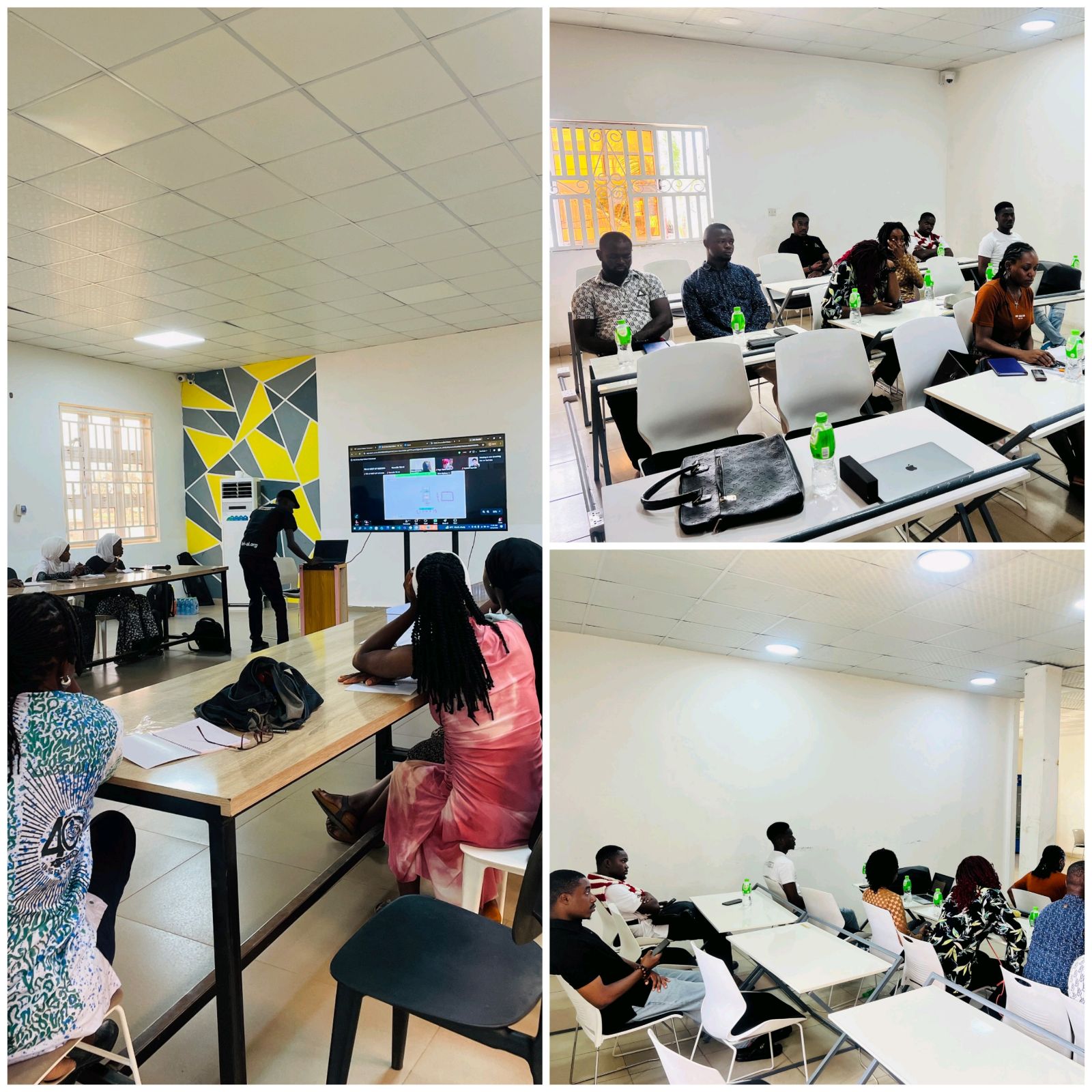
Cohort 10 brought together learners at different stages of their AI journey. Some were trying to figure out where to start, while others already had experience with AI projects and wanted to understand more deeply how the systems they were working with actually functioned.
Whether they were completely new to AI or already experimenting with projects, they were looking for something more than theory, a way to connect concepts to real problems.
Read the blog: TRI AI Saturdays Cohort 10 - Course 3 Summary Report
What Changed?
Ogechukwu Aina
Ogechukwu came into Cohort 10 with programming experience and had previously worked on a RAG project. However, she did not fully understand how the different parts of the system worked together.
Her goal was to move beyond simply using AI tools and understand how these systems are actually built.
Through the programme, she gained a clearer understanding of how retrieval systems work and how their different components come together. During the Cohort 10 competition, she took on the role of Lead AI Engineer and Technical Architect, helping design and build her team’s RAG system for agricultural information.
Joseph Ayemlo
When Joseph decided to start a career in AI and Machine Learning, he did not know where to begin. He searched for roadmaps online and spent months learning mostly through theory, but found it difficult to move into actual coding and implementation.
Joining Cohort 10 gave him an opportunity to put that knowledge into practice. Through the practical labs, he began connecting the concepts he had been learning with real applications.
One of his recent learning milestones was completing the Discover the Transformer Architecture course, where he explored attention mechanisms, multi-head attention, positional embeddings, transformer blocks, layer normalization, and text generation.
He has also developed a stronger interest in reading research papers and understanding how AI and Machine Learning are applied in research.
Lawrence Adagbon
Lawrence also came into Cohort 10 with previous experience building AI systems. His experience included working with RAG, but he wanted to understand more about what was happening underneath the tools.
That curiosity led him to explore problems around African languages, tokenization, and how language models process information.
For his Cohort 10 project, Lawrence built SuperBPE, a tokenizer designed to better handle African languages. The project explored how African words can be fragmented by tokenizers that are primarily optimized for English and other high-resource languages.
Through the project, he learned by building and gained a deeper understanding of the relationship between data, language representation, and AI systems.
MEET THE BUILDERS
After weeks of learning, experimenting, and building, nine teams made it to the Cohort 10 finals from more than 70 teams.
The finalist teams have completed their projects, developing AI-powered solutions to problems across different industries.
Explore the projects: View the Cohort 10 Finalists Projects
02 - INNOVATION
AI IN ACTION ACROSS AFRICA
Learning AI is only the first step. The real impact comes when it is put to work solving real problems.
Across Africa, people and organisations are already doing just that. Here are a few examples.
HAKIMU | Helping Lawyers Find Answers Faster
Legal research can mean digging through large volumes of court decisions to find the cases that actually matter.
Hakimu is building a multilingual AI-powered legal search engine that brings African laws and case law together, helping lawyers, judges and researchers find relevant cases faster.
And it is already moving beyond a search tool. In April 2026, Hakimu signed an agreement with the East African Court of Justice to deploy its AI-powered case-law research technology, with training and support for judges and court staff.
Try Hakimu: Website Link
MAZAOHUB | Putting AI to Work on the Farm
Smallholder farmers often can’t tell what’s going wrong with their soil or crops until it affects their harvest.
MazaoHub uses AI, soil data and weather information to help farmers understand what is happening on their farms and make better decisions.
It now reports more than 66,000 farmers and agronomists using the platform.
Learn more about MazaoHub: Website Link
AI DIAGNOSTICS | Listening for TB
Tuberculosis is treatable, but catching it early can be difficult in communities without easy access to X-rays or specialist care.
AI Diagnostics is tackling this with Ostium, an AI-powered digital stethoscope that listens to a patient’s breathing and flags possible TB in less than three minutes.
The device is designed for frontline health workers, making TB screening possible in places where X-ray equipment may not be available.
Learn more about AI Diagnostics: Website Link
03 - WHAT’S HAPPENING IN AI
AI Policy and Trends Across Africa
Across Africa, governments and regional organisations are moving from AI discussions to building policies, infrastructure, and systems around the technology.
Here are a few developments shaping the continent’s AI landscape.
Nigeria - Building with Local AI
Nigeria has opened its National AI Innovation Challenge, inviting developers, universities, startups, and researchers to build working solutions using N-ATLAS, Nigeria’s open-source multilingual AI model.
The model supports Yoruba, Hausa, Igbo, and Nigerian-accented English.
Read more: N-ATLAS National AI Innovation Challenge
Rwanda - Responsible AI
Rwanda’s National AI Policy focuses on using AI to support economic growth while promoting responsible and inclusive adoption.
Its policy framework covers areas including AI skills, data, infrastructure, innovation, and governance.
Read more: Rwanda National AI Policy
What This Shows
Across the continent, the AI conversation is becoming broader.
It is no longer only about using AI, but also about who builds it, what data it uses, what languages it supports, and how it should be governed.
04 - OPPORTUNITIES
Events, Jobs, and Learning
AI in Academic Research - Stellenbosch University
Learn how to use AI critically and ethically throughout the research process.
The online course runs 26–30 October 2026, with a hybrid capstone on 6 November 2026.
Application deadline: 12 October 2026
International Conference on Technology, Innovation & Youth, Abuja
Connect with professionals, researchers, and young people exploring technology, digital literacy, entrepreneurship, and youth innovation.
The conference takes place 20–21 October 2026 in Abuja.
Application deadline: 5 October 2026
05 - RIDDLE ANSWER
Did You Crack the Code?
“I start with a problem, but I am not the problem. I begin with an idea, I grow through testing, and I may fail before I work. I can start as a sketch and become something people can use. What am I?”
Answer: A Prototype
A prototype starts with an idea and gives it a form that can be tested. It may change, fail, or be rebuilt before becoming something useful.
That represents the central idea of this month’s edition: taking an idea, testing it, learning from what happens, and gradually turning it into something useful.
Thanks for reading.
Until next time, Keep the cards rolling ♥️
TEACHING · RESEARCH · INNOVATION
Subscribe © 2026 TRI AI · tri-ai.org